
What Is AI Journaling?
I began journaling in fifth grade after watching Doug, a cartoon about a boy who recorded his experiences in a journal. At first, I mostly wrote what had happened that day. I was a kid, so it wasn't especially deep or structured. But over time, it became the place where I tried to understand relationships, examine unfamiliar ideas, capture meaningful moments, and problem-solve my way through difficult decisions. Whenever something felt confusing, I wrote about it.
Writing allowed me to step out of the role of the person reacting to life and into the role of someone observing it. Instead of only living through an experience, I could examine what had happened, how I had responded, and what I might do differently. That ability to create distance is still one of the most powerful parts of journaling.
So for nearly 30 years, journaling has been how I make sense of my life.
Eventually, I moved from handwritten notebooks to Google Docs. I wanted a digital backup, but I quickly discovered other advantages: I could type faster, organize entries more easily, and search for specific names, events, or ideas. I also developed a ritual of reading what I had written on the same date in previous years. It felt like a way of meeting former versions of myself. I could see which goals I had accomplished, which worries had disappeared, and which problems seemed to return in a different form.
I thought I had created a powerful personal system. But it still had a limitation. A search bar could only find what I remembered to look for. It could retrieve the exact words I had used, but it could not easily uncover an experience I had forgotten or show me that I had described the same underlying problem in several different ways. My journal contained decades of information about my life, but I could only explore the small fraction I happened to remember.
Then AI changed what was possible.
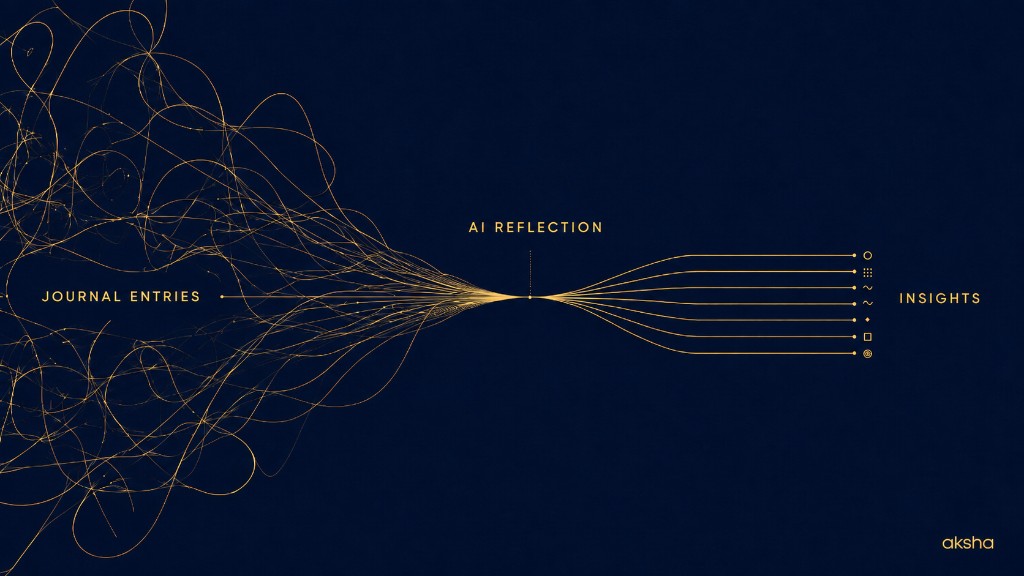
AI journaling uses artificial intelligence to help you connect past entries, explore recurring themes, notice possible emotional patterns, uncover blind spots, and ask better questions about your own experiences. A traditional journal records your reflections. An AI journal can help you reconnect those reflections across time.
It is not about asking a machine to tell you who you are. It is about making more of your own experiences available for reflection.
That difference eventually changed the direction of my life and led me to create Aksha.
My First Experiment With AI Journaling
When I first considered analyzing my journals with AI, I provided years of my own journal entries to a local AI model designed to interpret emotional language and began exploring which subjects appeared alongside different emotions. What it surfaced surprised me: Disappointment appeared repeatedly around work. Joy appeared most often around simple moments of human connection.
I did not treat the model's output as an objective verdict about my life. After all, generative AI can make mistakes. Instead, I treated the results as questions: Why did work appear so often beside disappointment? Was I investing enough time in the relationships that seemed to bring me joy? Was the life I was building still aligned with the person I had become?
The joy part made sense. It was not travelling to see famous landmarks that brought me joy, but the interesting people and conversations that I had during them.
But I felt confused about the work bit. For years, working in Bay Area tech had been part of my dream. I had built a successful career and had a well-paying job. From the outside, leaving did not make sense. But the dream had belonged to an earlier version of me. And I had changed. What I wanted from my work had changed too. The new me wanted to build something meaningful, something that could be useful to other people and contribute to their well-being. So I decided to quit my corporate job and build Aksha.
My AI journaling experiment did not make that decision for me. It showed me a pattern I needed to examine. Once I could see that broader picture, I could no longer dismiss each disappointing experience as a temporary frustration. The pattern became so obvious that I began to reconsider what I wanted my career, and my life, to be about.
How That Discovery Became Aksha
Aksha began as the tool I wished I had for myself. I wanted a journal that could do more than save entries in chronological order. I wanted it to help me rediscover the lessons, memories, emotional patterns, and moments of wisdom already contained in my writing.
Sometimes the answer we need is not somewhere out on the internet. It is already inside something we wrote years ago. The challenge is finding it.
When Laura and I began building Aksha together, we combined our backgrounds in neuroscience, software engineering, and cybersecurity. We shared the belief that technology could support self-discovery without taking ownership of the process away from the person doing the reflecting. We also wanted it to respect the fact that a journal may contain the most personal information someone has ever recorded.
That principle shaped the product: The journal belongs to you. The AI is there to help you explore it.
Today, Aksha combines traditional journaling with tools such as semantic search, personalized reflection prompts, and emotion analysis. These tools are designed to help people revisit relevant experiences, notice possible patterns, and reflect more deeply on what they have written.
What Can AI Journaling Help You Discover?
An AI journal can surface experiences and patterns that are difficult to retrieve from memory alone. It might show that the same problem has appeared under different circumstances, or bring forward an old insight that feels relevant today. But AI cannot automatically know why two subjects are connected, whether a pattern is meaningful, or what you should do about it. That interpretation still belongs to you.
The healthiest way to approach an AI-generated insight is as a hypothesis: “This appears to be a pattern. Does it feel true? What might explain it? Is there evidence in my life that supports or contradicts it?”
Sometimes the observation will lead somewhere important. Sometimes it will not. AI becomes most useful when it expands your curiosity rather than replacing your judgment.
What Does the Research Say About AI Journaling?
Research on AI-supported journaling is still emerging. Early studies have explored context-aware journaling and personalized AI-generated prompts as well as AI-augmented journaling experiences designed to support emotional awareness. The findings are promising, but the field remains young, and much more research is needed before broad claims can be made about mental-health outcomes.
For that reason, Aksha is designed as a self-reflection and personal-growth tool, not as a substitute for therapy, diagnosis, or professional mental-health care.
But the value of a journal is not determined by how many years it contains. A single honest entry can preserve an insight you might otherwise lose. A month of entries can begin to reveal what has been occupying your attention. Over time, those individual reflections become a record of how you think, choose, struggle, adapt, and grow. Each entry adds context for the person you will become.
Ten years from now, you may be able to look back across a decade of fears you overcame, goals that changed, relationships that shaped you, and lessons that once arrived quietly enough to be forgotten.
The best time to begin creating that record is now. Your future self may already need something you are about to write.
About Aksha
Aksha is an AI-powered journaling app created to help people process their experiences, explore emotional patterns, reconnect with past insights, and grow through guided self-reflection.
Aksha supports journaling across web, iOS, and Android, with tools including personalized prompts, emotion analysis, and semantic search across journal entries. Your journal data is encrypted and is never used to train Aksha's AI models.
References
1. Nepal, S., et al. “Contextual AI Journaling: Integrating LLM and Time Series Behavioral Sensing Technology to Promote Self-Reflection and Well-Being Using the MindScape App.” Extended Abstracts of the CHI Conference on Human Factors in Computing Systems, 2024. https://doi.org/10.1145/3613905.3650767
2. Wang, K., Barg, S., and Lawrence, R. “Designing for an AI-Augmented Journaling Experience: Balancing Guidance and Autonomy for Deeper Emotional Insight.” Extended Abstracts of the CHI Conference on Human Factors in Computing Systems, 2025, pp. 1–8. https://doi.org/10.1145/3706599.3719887
3. Autio, C., et al. “Artificial Intelligence Risk Management Framework: Generative Artificial Intelligence Profile.” National Institute of Standards and Technology, NIST AI 600-1, 2024. https://doi.org/10.6028/NIST.AI.600-1
4. Aksha. “Privacy Policy.” Accessed August 7, 2026. https://aksha.ai/privacy